
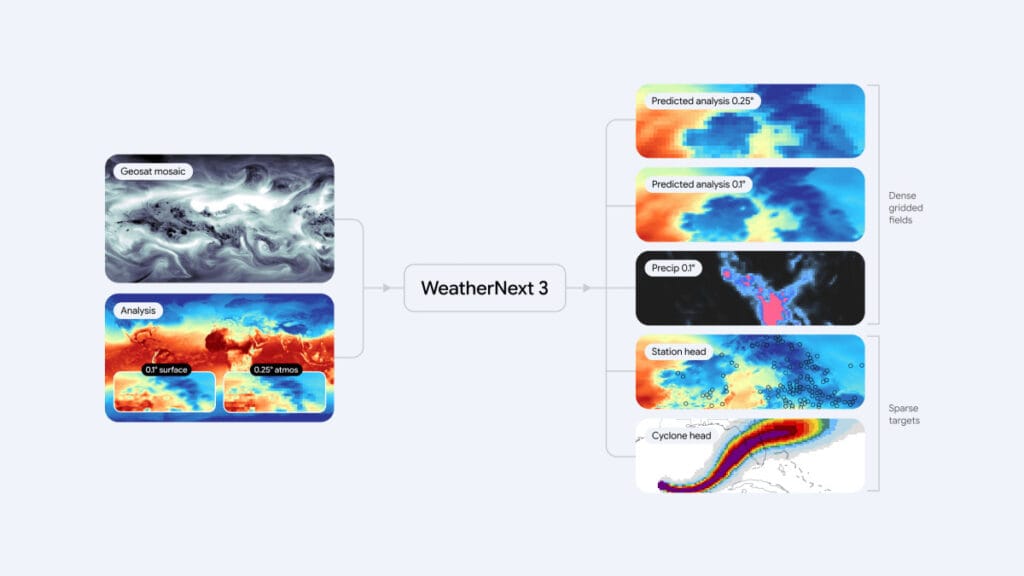
Google DeepMind and Google Research have introduced WeatherNext 3, a cutting-edge artificial intelligence model designed to enhance weather forecasting accuracy. This new model, unveiled on September 3, 2026, promises to provide clearer insights into atmospheric changes and more frequent predictions.
WeatherNext 3 represents a significant advancement in meteorology, utilizing deep learning techniques to improve the quality of weather information available across Google services, including Search, Google Maps, and Gemini. Users and researchers will also have access to this model through Google’s cloud platforms.
According to Samier Merchant, a senior staff engineer at Google, this model will integrate core weather variables into various Google products for the first time.
In tests conducted on the Operational WeatherBench, WeatherNext 3 emerged as the most accurate AI model, outperforming competitors from Microsoft, Nvidia, and the European Centre for Medium-Range Weather Forecasting (ECMWF). It surpassed traditional forecasts from the U.S. National Weather Service and ECMWF in key metrics such as temperature, wind speed, and humidity.
Traditionally, weather forecasts rely on government-operated supercomputers that process complex mathematical equations to predict weather patterns. While these systems have achieved remarkable accuracy, they are often costly and slower in generating forecasts. The release of over fifty years of weather data by the ECMWF in 2018 spurred deep learning researchers to develop models capable of making rapid predictions with comparable accuracy.
Ferran Alet, a staff research scientist manager at DeepMind, noted that the chaotic nature of weather means that small differences can have significant impacts. Machine learning addresses this challenge by learning patterns from extensive datasets.
WeatherNext 3 addresses several limitations of previous AI forecasting models, including their broad area coverage and reliance on formatted datasets from government agencies. The new model can predict weather conditions at a resolution of 5 km, significantly improving rainfall predictions by 60% compared to its predecessor, WeatherNext 2, and offering hourly forecasts instead of the standard six-hour intervals.
The enhancements stem from deliberate design choices, including a larger model with 2.4 times more parameters than its predecessor. This allows for more tailored predictions and improved visualization of cyclone paths.
Additionally, WeatherNext 3 is trained to provide forecasts specific to individual weather stations, enabling more granular predictions and better evaluation against actual data.
Daniel Rothenberg, an atmospheric scientist at Brightband, emphasized the importance of connecting forecasting tasks to core weather data, enhancing the model’s relevance and accuracy.
The model’s ability to generate more frequent forecasts is attributed to its capacity to process real-time satellite data on an hourly basis. This approach, which utilizes raw empirical observations rather than processed data from supercomputers, aims to deliver more precise forecasts, although it presents technical challenges.
While Google claims WeatherNext 3 is the first AI model to incorporate raw observations for high-resolution global forecasts, the AI weather startup WindBorne asserts that its WeatherMesh 6 model has been using raw observations from weather balloons since late 2025. Google maintains that its forecasts offer higher resolution globally, though both models still rely on national datasets for accurate predictions.
The integration of AI in meteorology is gaining traction, with European and U.S. weather agencies already employing AI models in their forecasting products. The speed and cost-effectiveness of these models could significantly benefit regions lacking access to high-quality sensors and supercomputers.
Bill Gates has highlighted AI-driven weather forecasting as a key advantage of the technology, noting its potential to enhance agricultural yields in developing countries. Alet added that improved forecasts of wind, rain, and cloud cover could bolster the reliability of renewable energy projects.
Ultimately, Alet stated, Google aims to provide users with valuable information, much of which is inherently linked to weather conditions.