
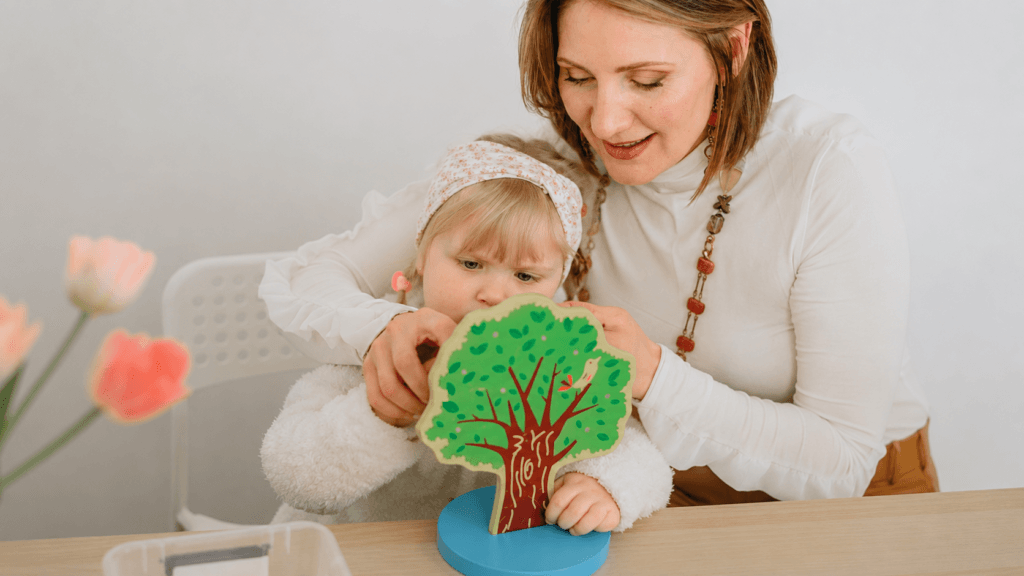
Each month, together with Maryna Usenko, we will explore the key stages of child development, including speech, behaviour and emotional well-being. We will also address the questions and concerns parents encounter most often.
The column’s expert, Maryna Usenko, is the creator of a developmental methodology for children with autism spectrum disorder (ASD), the founder of the international UMSPACE network of educational centres, and a specialist in child development, speech and special education. She holds a master’s degree in special education and has spent more than 27 years helping children and supporting families throughout the different stages of childhood.

Child Developmental Milestones: What Parents Should Look Out for and When to Consult a Specialist
Some people — and some words — stay with you for a lifetime. I still remember a mother once telling me: “I bring my child to you because no one else fights for their development or wants to help them speak as much as you do.”
Her child had a severe speech disorder, but with the help of my methodology and the dedicated work of my team, we were able to achieve remarkable results.
In this article, we will explore how a child’s development should progress, which signs parents should pay attention to, and when it is important to seek professional support rather than wait. Time is the most valuable resource in a child’s development because every developmental stage is connected to the next.
My name is Marina Usenko. I am the founder of UMSPACE, a network of educational centres in Kyiv and Warsaw, a Master’s graduate in Special Education, and the creator of a unique methodology for developing spontaneous speech in children with severe speech disorders.
For more than 27 years, I have worked with children with autism spectrum disorder and supported families throughout the different stages of childhood — from pregnancy to the age of nine.
Today, we will discuss the key stages of child development, the common mistakes parents make, and the issues that most often cause concern and uncertainty: What is considered typical? What should parents pay closer attention to? And when is it better not to wait, but to consult a specialist?
When a child is born, the family’s entire world begins to revolve around them. During the first year of life, we celebrate each month as a milestone. We buy the best toys, read extensively to understand what parenting truly means, listen to different bloggers, and turn to the “secret weapon” of advice passed down by older generations.
The most important thing I always ask parents to remember is the ultimate goal of parenting: to raise a psychologically healthy, mature adult.
To do this, we need to look beyond the moment when a child starts nursery or school and imagine them at the age of 30 — an independent adult with a good education, meaningful work, friends, and a loving partner.
When we begin to think this way, every parental decision takes on a new meaning: Who am I raising right now? Who will my child become if I continue to act in this way?
The brain begins to filter information differently, helping us build an entirely new approach to raising and supporting a child’s development. Many fears diminish because we have a clear vision of where we want to go. This represents a completely different level of awareness and thinking — one that we naturally pass on to our children.

The first concerns about a child’s development often arise between the ages of 18 months and two years. Parents may begin to sense that something is not quite right. However, friends and members of the older generation are usually quick to offer reassurance:
“Our child was exactly the same, and everything turned out fine.”
“Just wait — your child is simply lazy.”
“Children all start talking late these days.”
After hearing enough of this advice, a young mother may begin to silence the inner voice warning her that something could be wrong. She waits — and valuable time is lost.
Over 27 years of practice, I have heard many such stories. That is why I always encourage parents to listen to themselves first. Your intuition is trying to tell you something for a reason. If you feel that something may be wrong, do not dismiss that feeling — begin looking for answers with the help of qualified specialists.
There is no such thing as a “lazy” child when it comes to development. A child grows and develops as their nervous system matures and becomes ready for the next developmental stage.
For example, for a child to begin sitting independently, it is not enough simply to “teach them to sit.
” The nervous system must mature sufficiently for the brain to organise and coordinate the muscles of the torso — particularly the back and abdominal muscles that support the body and help maintain balance. Once this system is ready, the child will repeatedly attempt to sit up on their own.
Then comes the next stage. The mechanisms required for standing upright begin to mature: postural control, balance, coordination, and sufficient strength in the muscles of the torso and legs. The child begins pulling themselves up to stand.
At this point, it becomes almost impossible to persuade them to “lie still.” They pull themselves up, stand, fall, and stand again — not because we have forced them to do so, but because their nervous system is ready to master this new skill.
Speech develops in much the same way. It does not appear simply because a child has repeatedly been asked, “Say ‘Mama.’ Come on, say ‘Mama.’”
A complex network of neurological mechanisms must first mature. The auditory system, motor skills, attention, language comprehension, and the ability to control articulatory movements must all begin working together.
Therefore, when a child is not yet doing something, the first question should not be, “Why are they being lazy?” Instead, we should ask: “Is their nervous system ready for this skill, and is there anything preventing it from developing?”
It is also important to understand the mechanisms of child development and the role played by the brain’s mirror system.
Mirror neurons were discovered in the early 1990s by a group of Italian neurophysiologists at the University of Parma, led by Giacomo Rizzolatti. The researchers observed something remarkable: certain neurons became active not only when an action was performed, but also when a similar action was simply observed.
This is why a young child is constantly “reading” us. They watch the way their mother shapes her lips when producing a sound, how their father waves goodbye, and how we hold a spoon, clap our hands, smile, and gesture. At that very moment, the child’s brain is already processing the action they have observed. Later, the child attempts to reproduce it.
A significant part of early development therefore takes place through observation, imitation, and repeated practice. It is not enough simply to tell a child, “Do this.” They need to see us doing it, have an opportunity to try it themselves, and repeat it many times.
This is why parents and other close caregivers are a young child’s first and most important role models.
In this way, children gradually build their own experience. They observe adults and imitate their movements, gestures, facial expressions, and sounds — and later, their words. What a child initially only sees and hears gradually becomes a skill of their own.
By around the age of one, we generally expect the first meaningful words to appear. However, the number of words is not the only important indicator.
At this age, a child should also communicate actively with an adult: respond to their name, understand simple requests, use gestures, point to or hand over an object, wave goodbye, imitate an adult’s actions, babble actively, and attempt to repeat sounds and words.
Speech then begins to develop very rapidly. Between the ages of one and 18 months, we expect new words to appear, language comprehension to expand, and active imitation of adults to increase.
The child becomes increasingly able to understand simple requests such as “Give me the ball,” “Bring me the teddy bear,” or “Show me your nose.” They begin naming familiar people and objects and continue to use gestures actively.
As a child approaches the age of two, individual words are no longer enough — phrase speech should begin to emerge. The child starts combining two or more words, for example:
“Mama, give.”
“More water.”
“Daddy is coming.”
“I want to go outside.”
Their vocabulary expands rapidly. The child understands considerably more than they can express, follows simple instructions, and increasingly uses speech to communicate.
At this stage, I always ask parents not to focus solely on the number of words their child can say. What matters is the complete developmental picture: Does the child understand spoken language? Do they imitate others and use gestures? Do they seek interaction? Are new skills emerging? Is there consistent developmental progress?
To support a child’s development effectively, parents should establish a system of regular developmental check-ins and stop being afraid of neurologists and psychiatrists. These doctors are often best placed to identify a potential difficulty at an early stage — or to confirm that a child’s development is appropriate for their age.
For some reason, a psychiatrist remains the specialist parents fear most. Yet consulting a child psychiatrist should be viewed as a normal part of caring for a child’s health, just like visiting a dentist.
Memory, attention, thinking, perception, speech, emotions, behaviour, and the ability to interact with others are all components of a child’s psychological development.
A child psychiatrist does not simply assess whether a child has a psychiatric condition. They look at the child’s development as a whole: how the child connects with others, understands spoken language, behaves, plays, sustains attention, learns, and adapts to the world around them.
Sometimes, the outcome of such a consultation may be a recommendation for further assessment or professional support. At other times, parents may simply hear the most important words: “Your child is doing well. We will continue to monitor their development.”
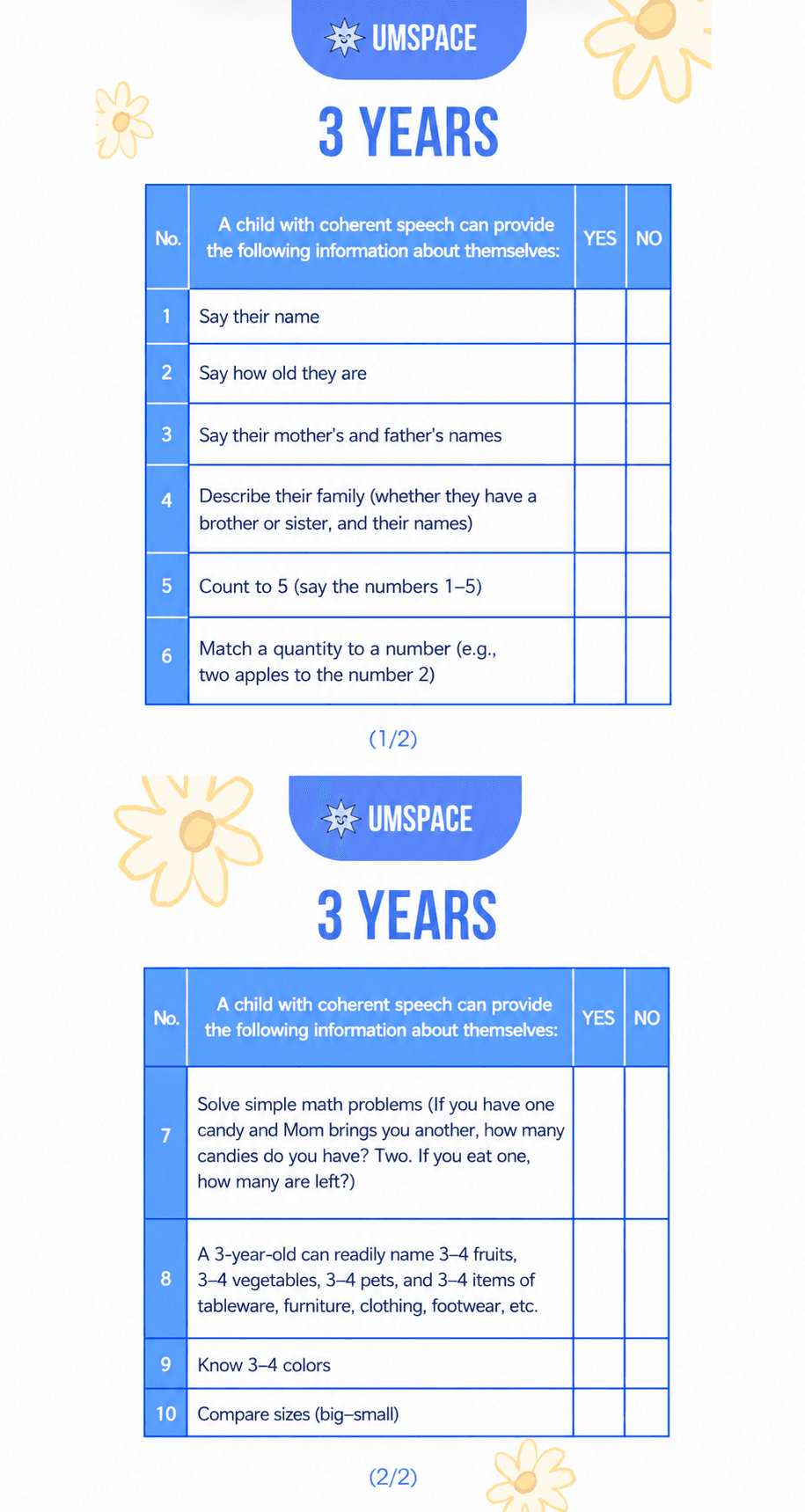
Below, you will find a table outlining the main developmental milestones by age. You can return to it from time to time to see which skills your child has already developed, which ones are currently emerging, and which areas may require closer attention.
If anything raises questions or causes concern, do not be afraid to consult a specialist — a speech and language therapist, psychologist, neurologist, or child psychiatrist.
It is always better to seek reassurance at the right time and learn that everything is progressing well than to lose precious time that could have supported your child’s development.
And remember: our task is not to raise a “convenient” or perfectly compliant child, nor is it to ensure that every milestone on a developmental chart is reached according to an exact timetable.
Our task is to help each child grow into a healthy, independent, and self-confident person who is capable of creating a happy life of their own.
A child’s future does not begin someday in the distance. It is being shaped today — and we are shaping it together.
Marina Usenko.
The article also includes a checklist for a quick at-home assessment.
Maryna Usenko Instagram https://www.instagram.com/maryna.usenko.pro/
Instagram of the children’s center in Kyiv: https://www.instagram.com/umspace_kindergarten/
Instagram of the children’s center in Warsaw: https://www.instagram.com/umspace.poland/